
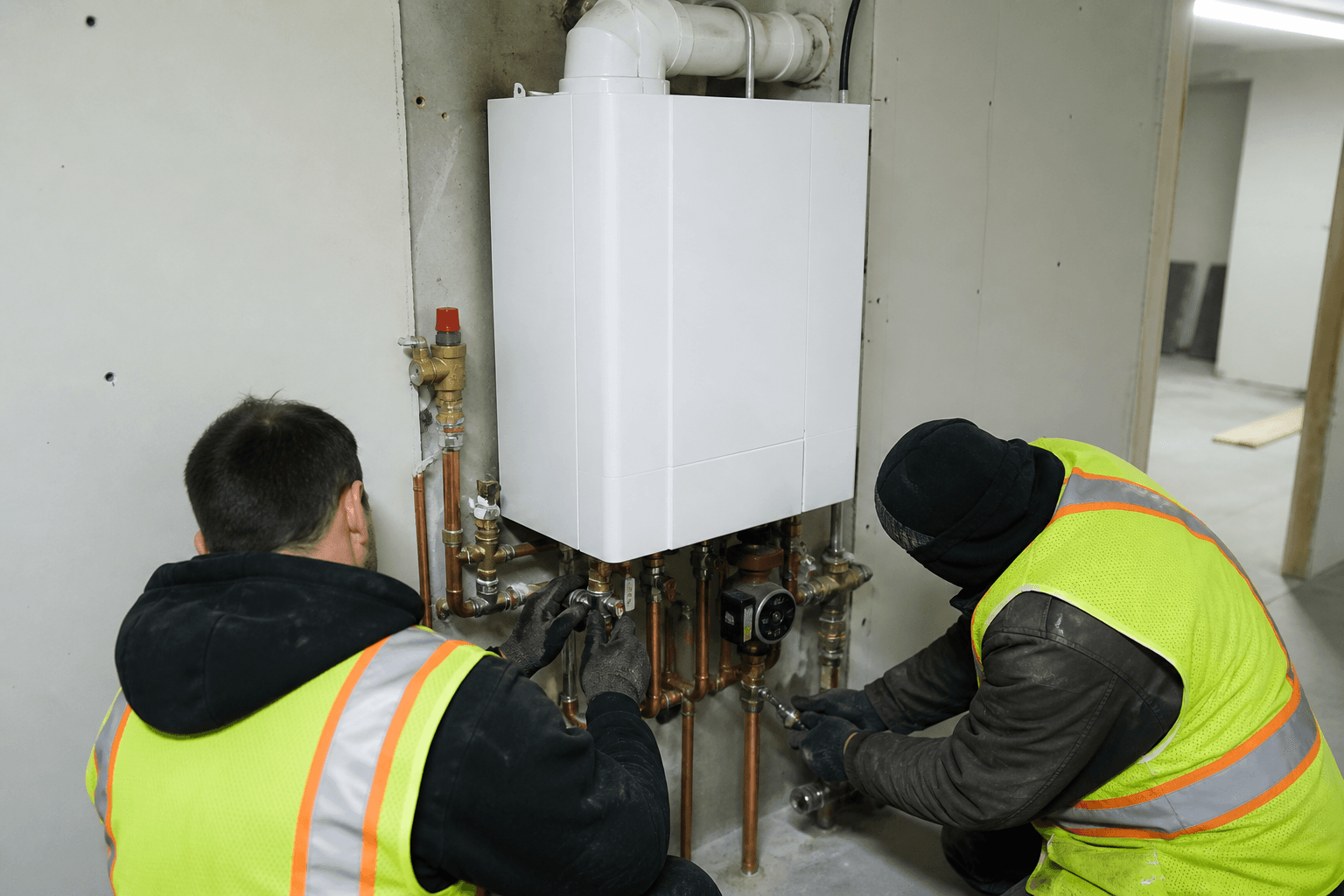
Most homeowners don't think about their boiler until it stops working — usually at 6 a.m. on the coldest morning of the year. By that point, you're not making a considered decision about repair vs. replacement; you're in crisis mode. This guide is for the homeowners who want to make that call before the emergency, not during it.
We've replaced hundreds of boilers across Langley and the Fraser Valley. Here's the honest, practical guide to knowing when it's time.
How Long Should a Boiler Last?
The answer depends on what type of boiler you have and how well it's been maintained. Here's a realistic breakdown based on what we actually see in the field:
| Boiler Type | Typical Lifespan | With Annual Servicing |
|---|---|---|
| Cast iron (Weil-McLain, Slant/Fin, Burnham) | 25–40 years | 40+ years possible |
| Steel sectional boiler (older design) | 15–25 years | 25–30 years |
| Modern condensing (stainless/aluminum HX) | 15–20 years | 20–25 years |
| Combi boiler (Navien, Rinnai, Bosch) | 12–18 years | 18–22 years |
If your boiler is past the midpoint of its type's expected lifespan and you're starting to see any of the signs below, the repair vs. replace math changes significantly. Putting money into a 28-year-old cast iron boiler might buy you another two winters, or it might not. A new unit comes with a manufacturer warranty and predictable performance.
7 Signs Your Boiler Is Telling You It's Done
1. It's failing more than once a year
One repair in a year is normal maintenance. Two or more starts to tell a story. When a boiler begins failing regularly — heat exchanger cracks, pump failures, ignition issues, blocked flues — it's usually because multiple components are reaching end of life simultaneously. You're no longer fixing one thing; you're chasing the system.
The practical test: add up every repair invoice from the last three years. If that total is approaching 50% or more of what a new installed boiler would cost, replacement is almost certainly the better financial decision.
2. Your gas bills are climbing without explanation
An aging boiler loses combustion efficiency as its heat exchanger surfaces oxidize, scale accumulates, and burner components degrade. A boiler that was 80% efficient when installed in 1998 might now be running at 65–70% — meaning 30–35 cents of every dollar you spend on gas is going up the flue.
Modern condensing boilers operate at 94–98% Annual Fuel Utilization Efficiency (AFUE). In a home that spends $2,400 per year heating with gas, the jump from 70% to 96% AFUE reduces that to roughly $1,750. The annual savings often fund a meaningful portion of the replacement cost over 10–15 years.
3. The heat exchanger is cracked or corroded
This is the one that ends the conversation. The heat exchanger is the core component that transfers combustion heat to the circulating water. When it cracks — from thermal cycling fatigue, internal corrosion, or physical damage — combustion gases can enter the distribution water, or worse, leak into the mechanical room.
A cracked heat exchanger is a safety issue, not just a performance issue. Carbon monoxide leakage is a real risk. And heat exchangers are not economically replaceable in most residential boilers — by the time one fails, the cost of a factory-rebuilt exchanger plus labour equals or exceeds the cost of a new unit. Replace the boiler.
4. Parts are becoming unavailable
Manufacturers typically guarantee parts availability for 10–15 years after a model is discontinued. After that, you're dependent on whatever stock remains in the supply chain — and for older boilers, that stock runs out. When we start telling a homeowner "this part has a six-week lead time and the supplier has two left in Canada," it's time to think about replacement.
Brands known for the longest parts availability: Weil-McLain and Burnham (cast iron components available for decades), followed by Viessmann and Bosch. Budget brands from big-box stores tend to have the shortest aftermarket support windows.
5. The system can't maintain temperature on cold days
If your boiler is running continuously but the house doesn't reach setpoint on the coldest days of the year, there are two possible causes: the boiler is undersized for your current heat loss, or it's lost output capacity due to age and fouling.
This symptom is particularly common in older homes that have had additions built without the heating system being upsized. If a Manual J heat load calculation shows your current boiler's rated output is below your home's actual heat loss, replacement is the only long-term fix — no amount of servicing can make an undersized boiler heat a space it was never rated for.
6. Visible rust, corrosion, or chronic leaks
Surface rust on the jacket is cosmetic. Rust in the flue connection or on the sections themselves is structural. Corrosion on cast iron sections often indicates external moisture intrusion — from a leaking relief valve, a waterlogged expansion tank depressurizing the system repeatedly, or chronic low-water events.
Slow, recurring leaks at section joints or at the boiler base often mean the iron sections themselves are weeping. These can sometimes be resealed once; they rarely stay sealed. If you're refilling the system regularly and can't find a single clear leak point, the boiler body is likely the source.
7. It was installed before 2000 and has never been serviced
We see this regularly in homes where the original owners stayed for 30 years. The boiler ran without ever being touched — no annual service, no combustion analysis, no flue inspection. These units sometimes run for a shockingly long time, but they're operating far below rated efficiency and often have safety issues that haven't been caught.
A boiler installed in 1994 and never serviced may have a flue with significant deterioration, a heat exchanger operating with dangerous CO concentrations, and controls that are years past their reliable service life. At some point, the responsible thing is to replace it before something goes wrong — not after.
The Repair vs. Replace Decision: A Simple Framework
Use this to guide your thinking — not as a rigid formula, but as a starting point for the conversation with your contractor:
Boiler is under 10 years old, single component failure, parts available
Repair. You're in normal maintenance territory.
Boiler is 10–15 years old, one repair needed, no history of issues
Repair once, but start planning for replacement in 2–5 years.
Boiler is 15–20 years old, second repair in 3 years
Get a replacement quote alongside the repair quote and compare 10-year total cost.
Boiler is 20+ years old, any significant repair needed
Replace. The repair cost is almost always better spent on a new unit.
Heat exchanger failure, any age
Replace. This component failure ends the economic case for repair.
Parts unavailable or 8+ week lead time
Replace. The risk of being without heat during parts wait is real.
What Does Boiler Replacement Actually Cost in Langley?
We don't publish prices because the range is genuinely wide — a straight combi boiler swap in a small townhouse costs very differently from a multi-zone radiant system replacement in a 4,000 sq ft home. But here are honest ballpark ranges for planning purposes, based on what we charge in the current Lower Mainland market:
- Straight combi boiler swap (same location, existing piping in good condition): $4,500–$7,500 installed, depending on brand and capacity.
- Single-zone conventional boiler replacement (like-for-like, 2–4 baseboard zones): $5,500–$9,000 installed.
- Multi-zone system replacement (4+ zones, new manifold, zone valves): $9,000–$16,000+ depending on system complexity.
- Boiler-to-heat-pump conversion: $15,000–$25,000+ installed, before CleanBC and BC Hydro rebates which can reduce this by $6,000–$10,000 depending on the qualifying system.
These ranges assume licensed, permitted work through the BC Safety Authority. You will sometimes see quotes significantly below these numbers from contractors who aren't pulling permits. Unpermitted gas work voids your home insurance and creates serious liability when you sell. It's not a real comparison.
Should You Consider a Heat Pump Instead of a New Boiler?
If you're already replacing the boiler, this is exactly the right time to evaluate a heat pump conversion — because you're already spending significant money on the heating system, and the incremental cost of going to a heat pump is lowest when you're starting from a replacement anyway.
The BC rebate programs are still active in 2026. A qualifying cold-climate heat pump system can attract $6,000–$10,000+ in combined rebates, which meaningfully changes the payback math. We submit all rebate paperwork on your behalf.
The main cases where a heat pump conversion is more complicated: homes with high-temperature cast iron radiator systems (the radiators need very hot water to work, and heat pumps run best at lower temperatures), and homes with very old piping that would need replacement regardless.
For most homes with baseboard heating and a boiler built after 1995, a heat pump conversion is at minimum worth evaluating seriously. We'll run the numbers with you before you commit to anything.
What to Do if Your Boiler Fails in Winter
This happens. Here's what to do in order:
- Check the basics first. Is the thermostat calling for heat? Is the pilot light out (older units)? Is the pressure gauge reading in the normal range (typically 10–20 PSI for a cold system)? Is the circulator pump making noise? Many "boiler failures" are actually a tripped reset button, a dead thermostat battery, or a pressure issue you can resolve in five minutes.
- Call for emergency service before giving up on repair. A failed igniter, a blocked condensate drain, or a tripped limit switch are all same-day fixes. You don't necessarily need a new boiler by tonight — you need a diagnosis first.
- If the boiler needs to be replaced urgently, communicate this clearly when you call. We prioritize emergency replacements and can often get a unit installed within 24–48 hours if the home is without heat.
- Protect your pipes. If the boiler will be down for more than a few hours in freezing weather, drain exposed piping or use electric space heaters in vulnerable areas — particularly in unheated crawlspaces and garages.
The Most Important Thing You Can Do Right Now
If your boiler is more than 15 years old and hasn't been serviced in the last two years, book a service call. Not because it's necessarily about to fail — but because a proper combustion analysis will tell you exactly where the unit stands. You'll know whether you have 10 years left or 18 months. That information is worth far more than the cost of the service.
Langley Boiler Installation Solutions offers annual boiler servicing across Langley and the Fraser Valley. A licensed tech, a combustion analyser, a written report. Call us and book before the heating season starts.